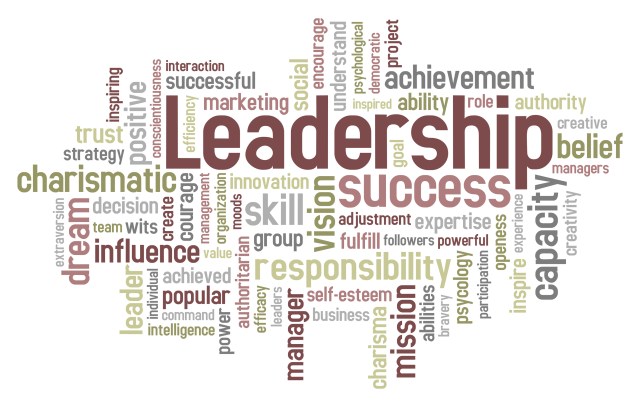
 What comes to mind when you hear the word “leadership”? I wonder what some of the images are that are evoked when you talk about “leadership development”? Are there certain people that pop up in the discussion? Are there past or present leaders whose quotes are invoked like some kind of ancient incantation that adds gravitas to the conversation?
In one of my grad-school textbooks that I had to read (all 400-pages), Edgar Schein* proposes the leader’s role in understanding and changing the culture of an organization. The leader needs to understand the macro, sub and micro-cultures of an organization. He believes that a leader’s role is to embed and transmits culture; a leader can actually lead by changing the culture of the organization. He argues that a leader does this through charisma, “that mysterious ability to capture the subordinates’ attention and to communicate major assumptions and values in a vivid and clear manner”. (Schein, Organizational Culture and Leadership. 235)
Ronald Heifetz, Alexander Grashow and Marty Linsky*, in their book, The Practice of Adaptive Leadership outline a series of practices a leader must do to lead an organization through the changes necessary to execute on the organizations strategic objectives. As a leader learns the systems within an organization, he or she must diagnose potential challenges in the organizations political landscape. Other leadership activities, according to the authors, are to design interventions, orchestrate conflict, build a certain type of culture, identify loyalties within the organization, stay connected to the purpose, inspire people, and the list goes on. According to the authors, a leaders role is multi-faceted, requiring of searing intellect, and requires an inordinate amount of energy.
There is a lot that can be gleaned from the leadership literature being printed; wisdom is found in many places and on many faces. The leadership books being printed can seem boundless, and to be honest much of it focuses on the practices and behaviors of leadership. This is because practices can be observed and reproduced; their is an empirical essence to this type of leadership development. But what is missing is the sapient texture in leadership; in other words, leadership development must connect the heart with the head and the hand. While a lot of attention is focused on what a leader must do, and this is important, we also must focus attention on who a leader must be.
Ancient middle-eastern wisdom literature focused on the development of humility in the process of leadership development. The practice common at that time was called kenosis; the word kenosis comes from the Greek verb ekenosen. Paul, in his letter to the church in Phillipi, wrote, “Christ Jesus . . . heauton ekenosen -that is, stripped, humbled, emptied himself – “taking the form of a servant, being born in the likeness of men” (Philippians 2:7). Jesus reveals to us the human face of God, a God who, in the foolishness of love, empties himself so that I may accept him in all freedom and that I may find room for my freedom in him.*
The Great Spiritual Leader, Jesus Christ, demonstrated how humility is the root essence in the development of leadership character. One cannot be a great leader unless one is willing to look at others with a modicum of compassion, empathy, and a desire to serve. The example of Jesus* is to empty oneself of all perception of worth, value, the desire for recognition and prestige. When one is practicing humility, they are putting others ahead of their own agenda.
True leadership development seeks to develop others and bring the best out in others in a way that shows honor, value and dignity to others without the need for personal applause.
His love for me brought low his greatness.
He made himself like me so that I might receive him.
He made himself like me so that I might be clothed in him.
I had no fear when I saw him,
for he is mercy for me.
He took my nature so that I might understand him,
my face so that I should not turn away from him.
Odes of Solomon 7 (The Odes and Psalms of Solomon R. Harris and A. Mingana II, pp.
240-241.)
*Schein, Edgar H. Organizational Culture and Leadership. (San Francisco: Jossey-Bass. 2010.)
*Heifetz, Ronald and Alexander Grashow and Marty Linsky. The Practice of Adaptive Leadership. (Boston: Harvard Business Press. 2009.)
*Clement, Olivier. The Roots of Christian Mysticism. (New York: New City Press.1993.)
*Philippians 2:7.


 Heart, Mind & Soul Care