
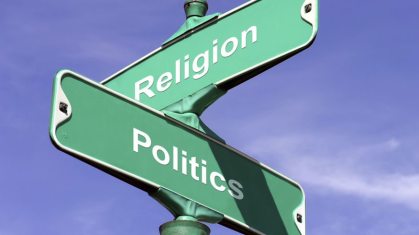
Regardless of one’s career path, they inevitably come across mentors who speak truth into their prospective leadership development paths. This is no less true with my life; I have had countless mentors, both dead (through their writings) and living, who have spoken wise words of counsel. One such truth spoken into my prospective career was this: “Pastors are to be surgeons of the soul. And part of our work is to discern the culture in which a soul lives.”
The current climate of the soul in Western Christianity witnessed the rise of a person into political power who, in large part, used the Evangelical platform to gain his position. One need not be to the right, to the left, moderate, independent, socialist, or any other political affiliation to recognize the influence of Christian evangelism in the past election. The Evangelical Christian church worked hard to elect a particular candidate. This much is true.
And this truth has caused many to wonder if, the evangelical church endorses such a candidate, can they with integrity call themselves an Evangelical, or even a Christian, if the majority of so-called Evangelicals support the political party who won the election. I have wrestled with this myself and I have not come to any easy conclusions. But I do have a few thoughts.
In Robert Kegan and Lisa Laskow Lahey’s work, “Immunity to Change”, they explain that the complexity of our world demands an increase in our complexity to meet these challenges. I cannot imagine anyone would argue against this concept. The authors make a statement that helps to frame the struggle as religion and politics have become so entangled. They write, “True development is about transforming the operating system itself, not just increasing your fund of knowledge or your behavioral repertoire.” As the church wrestles with a culture that sees the decay of the core values of evangelical Christianity, we must work toward transformation rather than simply data downloading in our lives.
The National Association of Evangelicals include four statements which one must believe to be considered Evangelical. They are:
- The Bible is the highest authority for what I believe.
- It is very important for me personally to encourage non-Christians to trust Jesus Christ as their Savior.
- Jesus Christ’s death on the cross is the only sacrifice that could remove the penalty of my sin.
- Only those who trust in Jesus Christ alone as their Savior receive God’s free gift of eternal salvation.
I would say the NAE has done a spectacular job reducing to its most simple form the truths of evangelicalism, as well as the ideology of Christianity. When one reads over these four tenants, they can be inspired and encouraged. This is what we are about. Not politics nor politicians.
In meeting the demands of a complex culture, Kegan and Lahey describe three stages of mental complexity: 1.) The Socialized Mind, 2.) The Self-Authoring Mind and 3.) The Self-Transforming Mind.*
The third stage of mental complexity is fascinating as it applies to the transformation of the American religious landscape. They state, “The self-transforming mind can stand back from its own filter and look at it, not just through it. And why would it do so? Because the self-transforming mind both values and is wary about any one stance, analysis, or agenda. It is mindful that, powerful though a given design might be, this design almost inevitably leaves something out. It is aware that it lives in time and that the world is in motion, and what might have made sense today may not make as much sense tomorrow.”
So . . . four take-aways as I process my faith and the current political/religious climate:
- One must adopt a more complex way of relating to the culture in which they live. This means, at the very least, the freedom to accept and reject terms that no longer serve the content as they once did.
- If the church succumbs to a cultural identity of a certain political party, what is true is one need not throw their identity with the church out with the political party if they do not agree with the political party. It is possible to take a look at our lens, not just through our lens. If one feels uncomfortable, or even trapped, by the terms our culture is using to market religion, then don’t use the terms. It is possible to agree with the content without accepting the package with which the content was wrapped.
- Moreover, if one agrees with the political party, it is wise and prudent to be wary of embracing a nationalism in one’s faith that can so easily ignore realities of injustice in the name of God. We will fail to see the historical landmarks in our faith if we think the Pope and the King will get along well all of the time.
- Our faith influences our cultural engagement. If one’s faith requires we jump ship from the culture in which we leave, we disengage the calling given to us, as people of faith, to bring human flourishing to all areas of life. Engage in politics, but do not let one’s identity be political.
*I will not explain all of this because the book is readily available and if one is interested they can pick up the book and read it; it’s well worth the price.
 Heart, Mind & Soul Care
This is so good. Your third bullet point at the end was my favorite, and I’m sure you know why. You have gained a new reader, my friend. I wish you had told me about your blog before!